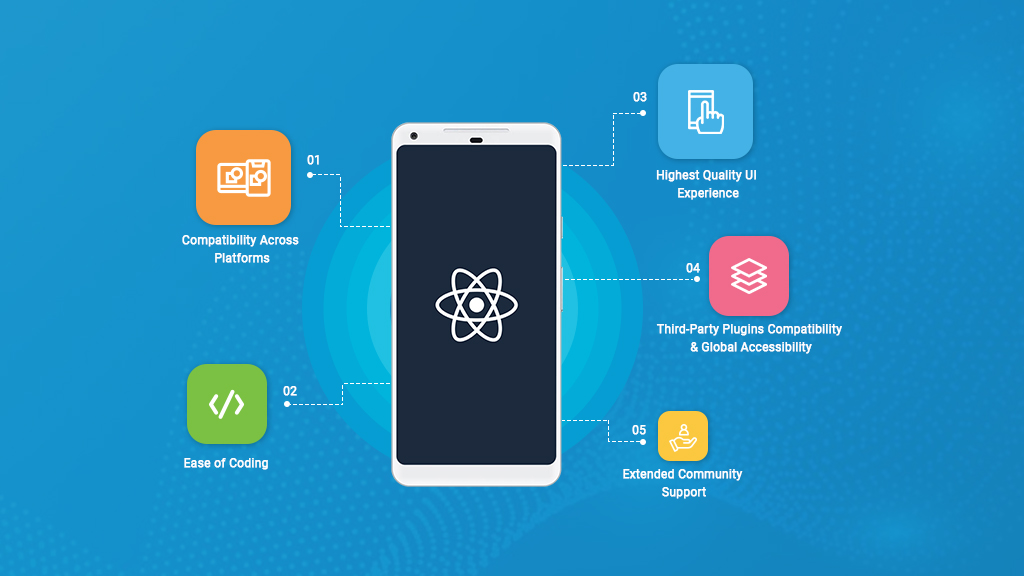
The Advanced Mobile App Development Using React Native course offered by Geneve Institute of Business Management presents a concentrated, practitioner-focused programme that advances developers from core React Native skills to professional-grade architecture, performance optimisation and operational readiness for production mobile apps. Over ten instructional units learners explore component architecture, cross-platform native integration, state management at scale, animation and gesture systems, testing and CI/CD, and release strategies for both iOS and Android. Emphasis is placed on durable design decisions, measurable performance improvements and robust integration patterns so participants can ship maintainable, high-quality applications that behave consistently across device classes and OS versions.
Target group
-
Experienced JavaScript or React developers aiming to produce production-quality native mobile apps using React Native.
-
Mobile engineers seeking to integrate complex native modules and platform-specific capabilities into cross-platform codebases.
-
Technical leads and architects responsible for defining app architecture, release strategies and long-term maintenance plans.
-
DevOps and release engineers who manage mobile build pipelines, code signing, and app store publishing workflows.
-
QA and automation specialists focused on test automation, flakiness reduction and CI strategies for mobile applications.
-
Product engineers and PMs who need deeper technical insight to scope features, prioritise performance and balance platform trade-offs.
Objectives
-
Architect scalable, maintainable React Native apps that separate concerns and enable long-term evolution.
-
Integrate and coordinate native modules, platform APIs, and third-party SDKs with reliable bridging patterns.
-
Achieve smooth, responsive UI through advanced animation, gesture handling and render-performance techniques.
-
Apply comprehensive testing strategies, automated pipelines and reproducible builds for both mobile platforms.
-
Optimise runtime performance and memory behaviour across diverse devices, OS versions and usage patterns.
-
Operate secure release workflows including signing, provisioning, app-store compliance, rollback and monitoring.
Course Outline
-
Component Architecture and Best Practices:
-
Designing small, composable UI components and establishing clear props/state boundaries.
-
Container-presentational patterns, separation of concerns and dependency inversion.
-
Organising project structure for scalable feature growth and team collaboration.
-
Reuse strategies: design tokens, shared UI libraries and cross-platform components.
Advanced State Management:
-
Choosing state strategies: context, Redux, Recoil, Zustand and when to combine them.
-
Local versus global state, selector patterns and memoisation to prevent unnecessary renders.
-
Managing asynchronous flows, optimistic updates and reconciliation of remote state.
-
Persisting state, migrations and handling schema changes across app versions.
-
-
Native Modules and Platform Bridges:
-
Anatomy of native modules on iOS and Android and safe bridge patterns.
-
Handling platform-specific permissions, lifecycle and background tasks reliably.
-
Interfacing with hardware: sensors, cameras, Bluetooth and platform services.
-
Versioning native APIs, graceful fallbacks and capability detection at runtime.
Cross-Platform UI Parity and Styling:
-
Styling systems: StyleSheet, theming, responsive scaling and adaptive layouts.
-
Achieving visual parity across form factors and pixel densities.
-
Typography, iconography and accessibility-first design considerations.
-
Managing platform-specific design idioms while keeping a shared codebase.
-
-
Performance and Rendering Optimisation:
-
Identifying bottlenecks: bridge overhead, JS thread, layout thrashing and reflows.
-
Techniques to minimise renders: PureComponent, React.memo and shouldComponentUpdate equivalents.
-
Reducing JS payloads, lazy loading screens and code-splitting approaches.
-
Reducing memory pressure, image optimisation and efficient asset pipelines.
Animations and Gesture Systems:
-
Animated API, Reanimated and native-driver strategies for smooth motion.
-
Gesture handling patterns: pan, swipe, complex interactions and gesture chaining.
-
Designing physics-based and interruptible animations for natural feel.
-
Offloading animation work to native threads to avoid jank and dropped frames.
-
-
Navigation and Deep Linking:
-
Navigation patterns: stack, tab, drawer and nested navigators at scale.
-
Handling deep links, universal links and linking to specific app states.
-
State restoration, navigation persistence and predictable back behaviours.
-
Coordinating navigation with modal flows, onboarding and authentication transitions.
Offline, Caching and Data Synchronisation:
-
Strategies for offline-first apps: caching layers, conflict resolution and reconciliation.
-
Local storage options: SQLite, MMKV, AsyncStorage and trade-offs.
-
Sync patterns for background uploads, resumable transfers and data integrity.
-
Consistency models and user-visible indicators for sync status.
-
-
Testing Strategies and Quality Assurance:
-
Unit testing components and utilities with fast-feedback unit suites.
-
Integration and end-to-end testing tools for React Native environments.
-
Reducing flakiness: deterministic test data, mocks and environment control.
-
Test coverage goals, regression prevention and smoke tests for release gating.
Continuous Integration and Delivery for Mobile:
-
Designing reproducible CI pipelines for iOS and Android builds and artifacts.
-
Automated signing, provisioning profile management and secure secrets handling.
-
Distributing pre-release builds, managing testers and feature-flagged rollouts.
-
Automating store submissions, metadata management and release notes generation.
-
-
Security, Privacy and Data Protection:
-
Secure storage of secrets and tokens, and safe inter-app communication patterns.
-
Hardening against common mobile threats, reverse engineering and tampering.
-
Privacy-by-design: minimising sensitive collection and implementing consent controls.
-
Compliance touchpoints: logging, telemetry minimisation and data retention choices.
Monitoring, Crash Reporting and User Feedback:
-
Choosing observability tools for performance, crashes and user flows.
-
Instrumenting breadcrumbs, contextual logs and measurable user events.
-
Prioritising issues from crash analytics and correlating with releases.
-
Collecting actionable user feedback and routing insights to product teams.
-
-
Native Performance Profiling and Diagnostics:
-
Using platform profilers to analyse CPU, memory and battery usage.
-
Diagnosing layout and render stalls using hierarchical inspection tools.
-
Interpreting traces to attribute work to JS, bridge or native subsystems.
-
Building lightweight instrumentation to gather representative production signals.
Build Optimisation and Binary Size Reduction:
-
Reducing bundle size: tree-shaking, code stripping and resource pruning.
-
Native dependency audit and minimizing transitive binary growth.
-
Architecture-specific builds, ABI compatibility and linker considerations.
-
Split-apk/aab strategies and dynamic feature modules to manage install size.
-
-
Accessibility and Internationalisation:
-
Implementing accessibility roles, labels and navigation order for assistive tech.
-
Handling localisation, pluralisation and right-to-left layout support.
-
Testing accessibility across platforms and device types for real-world validation.
-
Designing inclusive UI patterns for diverse user needs and contexts.
Advanced UX Patterns and Native Feel:
-
Platform-consistent gestures, transitions and motion language for perceived quality.
-
Native-like performance affordances: haptics, quick actions and deep integrations.
-
Handling onboarding, permission flows and first-run experiences sensitively.
-
Micro-interactions and feedback loops that enhance user engagement.
-
-
Release Management and App Store Strategies:
-
Preparing metadata, screenshots, localised descriptions and compliance assets for stores.
-
Managing phased rollouts, staged releases and A/B experimentation on store platforms.
-
Handling app review processes, appeals and policy compliance proactively.
-
Versioning strategies, migration plans and user communication for breaking changes.
Maintaining and Evolving Large Codebases:
-
Refactoring patterns, modularisation and dependency boundaries to reduce entanglement.
-
Migration strategies for major upgrades of core libraries and native SDKs.
-
Establishing contribution gates, CI policies and release cadences for stability.
-
Knowledge transfer, documentation and onboarding tactics for growing teams.
-
-
Integrations with Backend Services and Push:
-
Designing efficient push notification handling, topics and silent updates.
-
Secure long-lived connections, websockets and presence semantics for mobile.
-
Backend-for-Frontend patterns and API shaping for mobile constraints.
-
Handling telemetry, batching uploads and minimizing user-visible network cost.
Emerging Patterns and Future Directions:
-
Advances in React Native architecture, Fabric and TurboModules implications.
-
Cross-platform frameworks comparison and when to mix native and JS work.
-
Trends in mobile hardware, A/B testing, and dynamic feature delivery.
-
Evaluating new tools responsibly and establishing pilot-to-production criteria.
-
Venues and dates
This programme runs every month in the following cities. Select a venue to register.
 Geneva
Switzerland
 Zurich
Switzerland
Basel
Switzerland
 London
UK
 Manchester
UK
 Oxford
UK
 Madrid
Spain
 Barcelona
Spain
 Paris
France
 Rome
Italy
 Vienna
Austria
Oslo
Norway
 Athens
Greece
 Copenhagen
Denmark
 Berlin
Germany
 Munich
Germany
 New York
USA
 Washington
USA
 Dubai
UAE
 Istanbul
Turkey
 Amsterdam
Netherlands
 Brussels
Belgium
 Lisbon
Portugal
 Malaga
Spain
 Milan
Italy
 Dusseldorf
Germany
 Prague
Czech Republic
 Budapest
Hungary
 Stockholm
Sweden
 Sheffield
UK
 Bangor
UK
 Ankara
Turkey
 Abu Dhabi
UAE
 Doha
Qatar
 Riyadh
Saudi Arabia
 Jeddah
Saudi Arabia
 Dammam
Saudi Arabia
 Muscat
Oman
 Amman
Jordan
 Cairo
Egypt
 Sharm El Sheikh
Egypt
 Casablanca
Morocco
 Marrakesh
Morocco
 Agadir
Morocco
 Tangier
Morocco
 Tunis
Tunisia
 Kuala Lumpur
Malaysia
 Singapore
 Jakarta
Indonesia
 Phuket
Thailand
 Tokyo
Japan
 Beijing
China
 Los Angeles
USA
 California
USA
 Toronto
Canada